
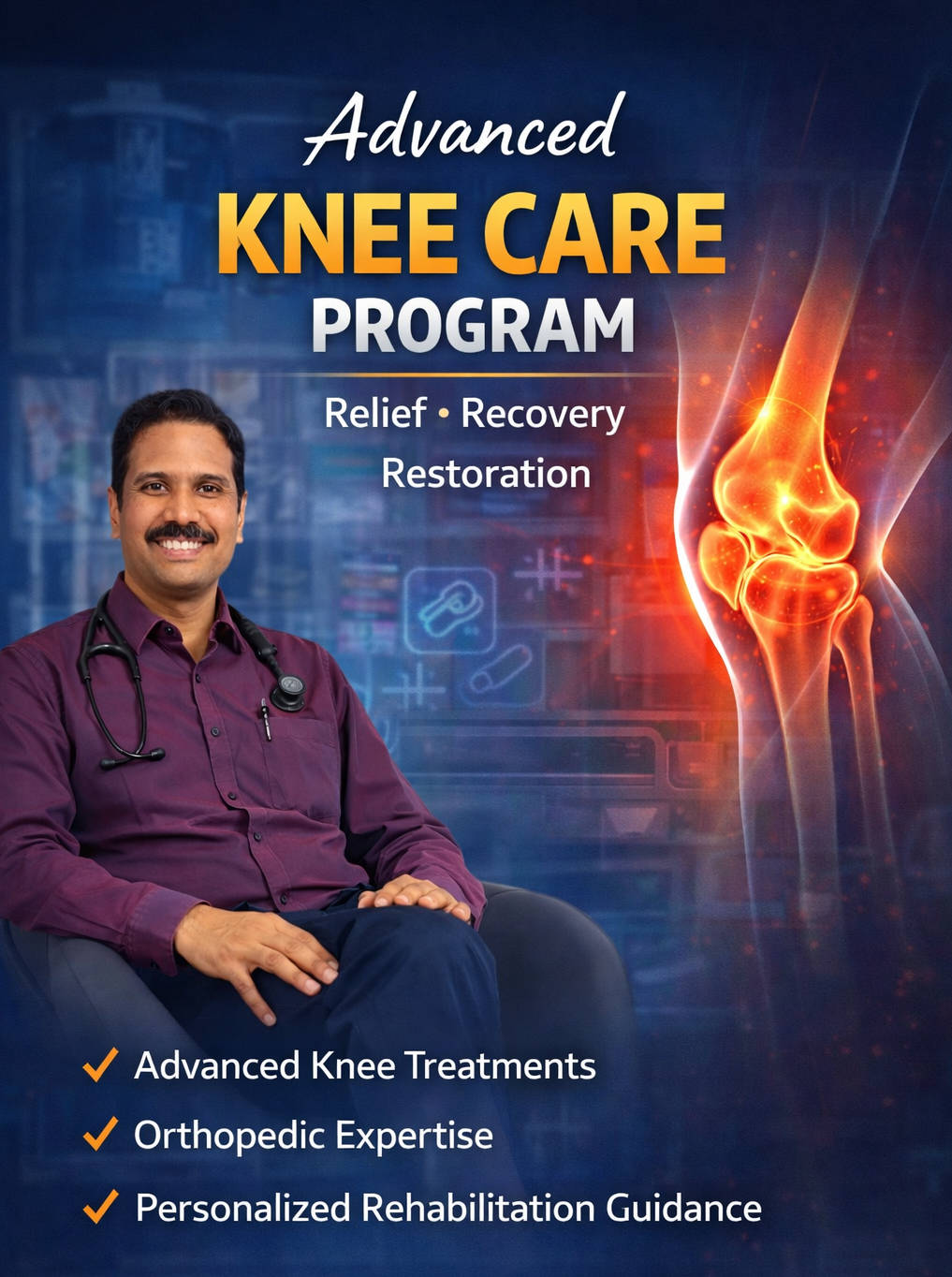
Dr Harsha ‘s Advanced
Knee - Care Programme
Walk Pain-Free Again. Avoid Knee Replacement Surgery
What's Included:
Physician-Led Program
MBBS + MD + DM + Fellowship + Lifestyle Medicine Specialist
6–12 Month Structure
Not a diet. A protocol. Complete balance of Medication + Lifestyle
Root Cause Protocol
Identifying the Root Cause , Not Symptom Suppression .
India's Only Medication+ Lifestyle
Personalised , with Risk factor analysis - Prevent , Treat and Reverse
EXPLORE OUR BEST PACKAGE
If you've been told knee replacement is 'inevitable,' you're not out of options. Dr. Harsha's Advanced Knee Care Programme addresses the root causes most orthopedic doctors ignore: weak hips, tight ankles, excess weight, muscle imbalances, and chronic inflammation.
Many patients reduce pain by 60-80% and avoid surgery entirely. Those who do eventually need surgery enter it stronger, heal faster, and get better outcomes.
6 Month Plan
6090 /month
₹36540
1 nos included
1 nos included
monthly once
monthly
Best Value
12 Month plan
4545 /month
₹54540
2 Nos included
3 nos included
monthly Twice
monthly Twice
24 month plan
3730 /month
₹89540
4 nos included
8 nos included
On call Support
Intensive
Every 1kg of weight you lose = 4kg of pressure off your knee joint. Even 5kg makes a dramatic difference.
Why Most Knee Pain Isn't Actually a Knee Problem
THE ROOT CAUSES THAT RARELY GET ADDRESSED:
If Any of This Sounds Familiar —
Is This Program Right for You?
You have chronic knee pain from arthritis, osteoarthritis, meniscus damage, or wear-and-tear — and it limits your daily activities.
Your orthopedic surgeon has mentioned knee replacement surgery as an option — and you want to explore non-surgical alternatives first.
You struggle with stairs, squatting, prolonged sitting, or walking — activities that should be simple but now cause pain.
You're overweight and your doctor says weight loss would help your knees — but you need structured guidance, not generic advice.
You've tried painkillers, generic physiotherapy, knee braces, or ayurvedic treatments — but nothing has provided lasting relief.
STRENGTHEN THE FULL KINETIC CHAIN
Not just your knee — your hips, glutes, quadriceps, ankles, and core. Targeted strength training builds the muscular support system that takes pressure off your knee joint. Weak hips = unstable knees. We fix the foundation.
RESTORE MOBILITY & FUNCTION
Mobility work for tight ankles and hips, balance and proprioception training, and pain-free movement patterns. As your body relearns proper biomechanics, knee pain decreases naturally. You regain the ability to climb stairs, squat, walk, and live without constant pain.
OPTIMIZE WEIGHT & REDUCE INFLAMMATION
Even 5kg of weight loss significantly reduces knee pain - 1:4 pressure ratio. The program works on fat reduction through metabolic optimization — not calorie restriction alone. It also address systemic inflammation through anti-inflammatory protocols (diet, sleep, stress management).
MINIMIZE PAINKILLER DEPENDENCY
Long-term NSAID use damages your stomach, kidneys, and liver. As inflammation decreases, muscle strength improves, and weight optimizes, most patients naturally reduce painkiller usage. This is always physician-supervised and gradual — never forced or rushed.
WHY DR. HARSHA'S APPROACH WORKS WHERE OTHERS FAIL :
The Longer You Wait, The Harder Recovery Becomes.
Knee cartilage doesn't regenerate. Every day of pain is a day of continued damage. The window to strengthen your knee before it's too late is closing. Many patients wait until it's bone-on-bone — and then surgery is the only option. But what if you could avoid that entirely?
What if 6 months from now, you could climb stairs without wincing, play with your grandchildren on the floor, and walk pain-free?
One consultation. One structured program. One decision.
UNBEATABLE VALUE
BEFORE: Pain level 7/10 | Weight 92kg | Couldn't walk 15 minutes | Stopped playing cricket | Told surgery needed within 2 years
AFTER (12 months): Pain level 2-3/10 | Weight 84kg | Walking 4km daily | Playing cricket again | No surgery needed
"Two orthopedic surgeons told me surgery was inevitable. I decided to try Dr. Harsha's program first. It wasn't easy — I had to lose weight, strengthen my hips, and change my lifestyle. But 12 months later, I've lost 8kg and my pain is 70% gone. I'm playing cricket again. I thought I'd never do that. Surgery isn't off the table forever, but for now, I don't need it."
Amit sharma , 48,
Bangalore
BEFORE: Pain level 8/10 daily | 3 painkillers/day | Weight 74kg | Couldn't climb stairs
AFTER: Pain level 2/10 | 1 occasional painkiller | Weight 67kg | Climbing stairs normally, playing with grandkids | 6 months
" Dr. Harsha said my knee wasn't the problem — my weak hips and weight were. He was right. 6-7 months later, I was pain free, I've lost 7kg, my pain dropped from 8/10 to 2/10, and I can easily climb staircase. I have also reduced the risk of Falling and further fractures.
meera , 58
Homemaker, Koppal
Q: Can knee pain be reduced without surgery?
Yes — many patients with chronic knee pain avoid surgery through structured intervention targeting root causes: weak hips (destabilize the joint), tight ankles (shift load incorrectly), excess weight (1kg body weight = 4kg pressure on knee), muscle imbalances, and inflammation. Dr. Harsha's Advanced Knee Care Programme addresses all of these systematically. Many patients reduce pain by 60-80% and avoid surgery entirely. Those who do eventually need surgery enter it stronger and recover faster.
Q: What is the cost of knee replacement surgery vs non-surgical treatment?
A: Knee replacement surgery in India costs ₹3-6 lakh, with 3-6 months recovery before walking normally and 12+ months for full recovery. The implant lasts 15-20 years, then requires revision surgery. Dr. Harsha's Advanced Knee Care Programme costs ₹36,000 for 6 months or ₹55,000 for 12 months — addressing root causes to avoid or delay surgery. Even if surgery becomes necessary later, patients who complete the program enter it stronger and heal faster.
Q: How much weight loss is needed to reduce knee pain?
A: Even 5kg of weight loss significantly reduces knee pain because every 1kg of body weight equals 4kg of pressure on the knee joint during walking. The program targets visceral fat (belly fat) specifically through metabolic optimization. Typical weight loss: 3-8kg in the first 90 days. For overweight patients with knee pain, weight optimization is often the single most effective intervention.
Q: What is the difference between physiotherapy and this knee care program?
A:Physiotherapy focuses on strengthening the knee joint and surrounding muscles — which is critical. This program goes beyond that by addressing the full kinetic chain: hip strength (weak hips destabilize the knee), ankle mobility (tight ankles shift load), weight optimization (reduces pressure), inflammation reduction, and pain management without long-term painkiller dependency. Physiotherapy helps the knee. This program fixes why the knee is failing in the first place.
Q: Can arthritis in the knee be reversed?
A:Cartilage damage from arthritis cannot be fully regenerated. However, the progression can be slowed or stopped through structured intervention. Many patients experience 60-80% pain reduction, improved mobility, and restored function without surgery. The earlier you intervene, the more cartilage you can preserve. Once it's bone-on-bone, surgery becomes the only option — which is why early action matters.
Q: How long does it take to see improvement in knee pain?
A: Most patients report initial pain reduction within 4-6 weeks as inflammation decreases and muscle imbalances start correcting. Significant functional improvement (climbing stairs, squatting, walking without pain) typically appears over 3-6 months. Long-term stability and maximum pain reduction occur over 6-12 months. Individual timelines vary based on severity, weight, adherence, and underlying damage.
Q:What exercises are included in the knee care program?
A:The program includes targeted strength training for hips, glutes, and quadriceps (the muscles that stabilize the knee), mobility work for ankles and hips, balance and proprioception training, and low-impact cardiovascular exercise. Exercises are customized to your current pain level and function — you never do movements that aggravate pain. As your knee strengthens, exercises progress. This is not generic YouTube physio — it's personalized and physician-supervised.
Q: Will I need to stop taking painkillers during the program?
A: No — painkiller adjustments are made gradually as your pain reduces. The goal is to minimize long-term dependency on NSAIDs and other painkillers, which have side effects with prolonged use. As inflammation decreases, muscle strength improves, and weight optimizes, most patients naturally reduce painkiller usage. This is always physician-supervised and based on your actual pain levels — never forced or rushed.
"In my 15 + years of preventive care practice, I've seen hundreds of patients told that knee replacement surgery was 'inevitable' — only to watch them walk pain-free months later without ever going under the knife.
Here's what most people don't understand: knee pain is rarely just about the knee.
When I assess a patient with chronic knee pain, I'm not looking at their knee in isolation. I'm looking at their hips (are they weak and destabilizing the joint?), their ankles (are they tight and shifting load incorrectly?), their weight (every 1kg you carry = 4kg of pressure on your knee), their inflammation levels, their movement patterns, and their overall metabolic health.
The knee is the victim — not the cause.
Standard orthopedic care treats the knee. My program fixes why the knee is failing in the first place.
Will everyone avoid surgery? No. Some cartilage damage is too advanced. But even those patients who do eventually need surgery benefit massively from entering it stronger, with better muscle support, and optimal weight. Their recovery is faster and their outcomes are better.
The question isn't whether you'll need surgery someday. The question is: what are you doing today to give yourself the best possible chance of avoiding it — or optimizing for it?
That's what this program does.
— Dr. Harsha
MEDICAL DISCLAIMER
This program is a physician-supervised lifestyle medicine intervention for chronic knee pain management. It is not a replacement for orthopedic care. Individual results vary based on pain severity, cartilage damage, weight, adherence, and underlying conditions. Cartilage damage from arthritis cannot be fully reversed, but pain and function can be significantly improved in many patients. Not all patients will avoid surgery — this program aims to delay surgery, reduce pain, and optimize surgical outcomes when surgery becomes necessary. Medication changes are always coordinated with your orthopedic doctor. Dr. Harsha's Lifestyle & Prevention Center provides evidence-based lifestyle support as an adjunct to standard medical care. Consult your orthopedic specialist before beginning this or any knee pain program.

Dr Harsha's Lifestyle and Prevention Center, helps in preventive health in Bangalore. Different packages similar to blood test are done here. Tailored diet and exercise plan for Heart attack, Diabetics, Stroke, Cancer, High BP and other chronic-diseases are available here.
Main Links
CONTACT
© 2025, Dr Harsha's. All Rights Reserved | Terms & Conditions | Privacy Policy | Refund Policy